
The Geoeconomic Pivot: Redefining Gulf-Horn Relations Beyond Transactional Security
This policy insight draws on the panel discussion of the 3rd Red Sea and Gulf of Aden Dialogue, convened by Ethiopia’s Institute of Foreign Affairs (IFA) under the theme “Navigating Gulf-Horn Economic and Security Cooperation: Opportunities, Challenges, and Future Directions.”
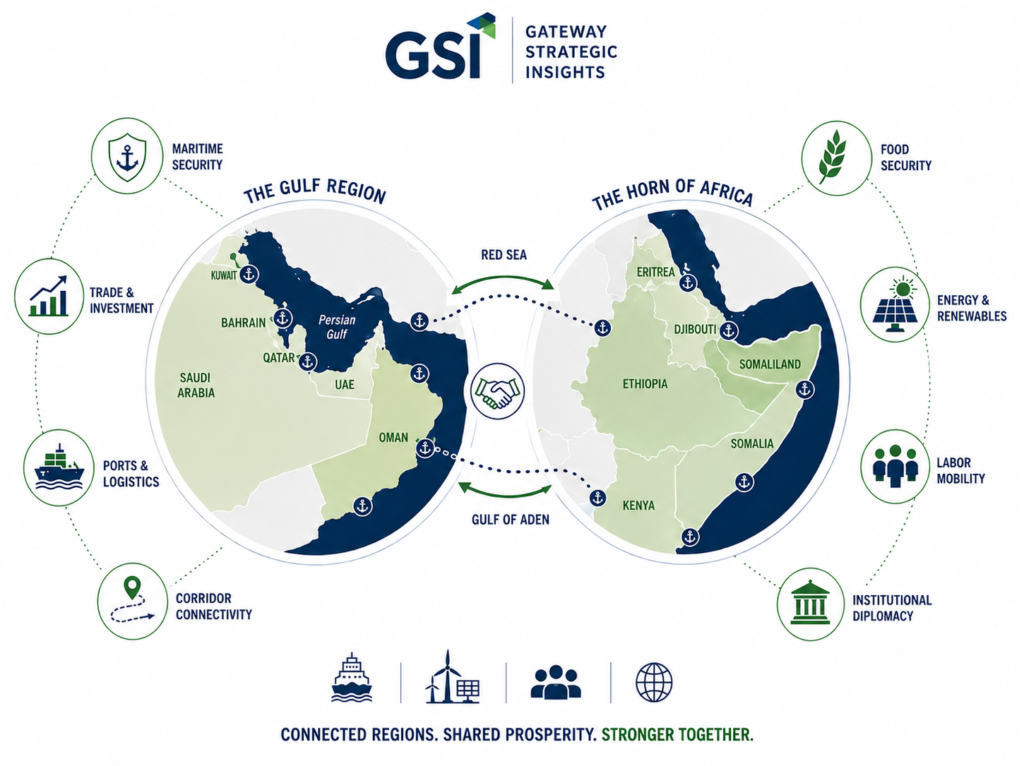
The panel discussion underscores an increasingly important strategic reality: the Red Sea and Gulf of Aden can no longer be understood primarily through the lenses of military security, maritime threats, and short-term bilateral alignments. Together, they form a wider geoeconomic space connecting the Gulf, the Horn of Africa, East Africa, and global markets.
The discussion highlighted the growing interdependence between regional stability, maritime access, trade, investment, infrastructure, and economic cooperation. This creates an opportunity to rethink Gulf-Horn relations, shifting from predominantly security-driven and transactional engagement toward a more integrated framework for long-term economic and strategic cooperation.
GSI View: From Transactional Engagement to Strategic Interdependence
Gateway Strategic Insights (GSI) argues that the next phase of Gulf-Horn relations should move beyond fragmented bilateral arrangements toward vision-to-vision cooperation anchored in economic complementarity, regional connectivity, and shared strategic interests.
Three priorities should shape this transition:
1. Build Corridors, Not Simply Ports
Maritime access should be approached as part of a wider regional connectivity system. Ports achieve their greatest strategic and economic value when linked to productive hinterlands, transport corridors, dry ports, industrial zones, energy networks, and regional markets.
In this context, Berbera Port and the Berbera-Ethiopia Corridor demonstrate the potential for a new model of Gulf-Horn cooperation. Somaliland offers a strategically located maritime gateway; Ethiopia provides the scale and demand of a major landlocked economy; and Gulf partners bring capital, logistics expertise, technology, and access to international markets.
The policy objective should therefore shift from competition among individual ports toward the development of integrated, commercially viable, and mutually reinforcing corridor systems.
2. Transform Resource Complementarity into Strategic Interdependence
The Horn of Africa possesses substantial agricultural, livestock, fisheries, mineral, solar, and wind resources. Gulf economies, meanwhile, bring investment capital, advanced technologies, logistics capabilities, sophisticated markets, and sustained demand for food, energy, and strategic commodities.
The opportunity is to move beyond a conventional investor-recipient model toward co-investment and integrated value-chain partnerships that connect Gulf food and energy security with industrialization, employment generation, technology transfer, and export diversification across the Horn. This is where geoeconomics can also become an instrument of stability. Countries and communities connected through infrastructure, investment, markets, and productive value chains develop stronger incentives to preserve predictable and peaceful regional relations.
3. Institutionalize Gulf-Horn Economic Diplomacy
Despite their deepening interdependence, Gulf-Horn relations remain institutionally fragmented. Maritime security, ports, trade corridors, labor mobility, food security, energy, and investment are still largely addressed through separate bilateral arrangements.
GSI therefore sees a need for a more structured Gulf-Horn economic and strategic dialogue that connects the GCC, IGAD, relevant governments, coastal and corridor actors, development institutions, sovereign investors, and the private sector.
Such a framework should complement existing diplomatic mechanisms by bringing trade, investment, infrastructure connectivity, maritime security, resource cooperation, and economic resilience into a shared strategic agenda.
Strategic Takeaway
The next chapter of Gulf-Horn relations should not be defined primarily by competition over who controls the Red Sea, but by how the countries and economies surrounding it can collectively create value from it.
For GSI, sustainable stability across the Red Sea and Gulf of Aden will depend on a mutually reinforcing equation: maritime security protects economic corridors; corridors connect markets; investment expands productive capacity; and deeper economic interdependence strengthens incentives for political cooperation and regional stability.
The required strategic transition is therefore clear:
From security transactions to geoeconomic partnerships.
From isolated ports to integrated corridors.
From fragmented bilateralism to long-term Gulf-Horn strategic interdependence.
Source of discussion: Institute of Foreign Affairs (IFA) Ethiopia, Panel Discussion on the 3rd Red Sea and Gulf of Aden Dialogue, examining Gulf-Horn economic and security cooperation, opportunities, challenges, and future directions.
Gateway Strategic Insights (GSI)
Trade & Investment | Maritime Security | Regional Integration | Geopolitics